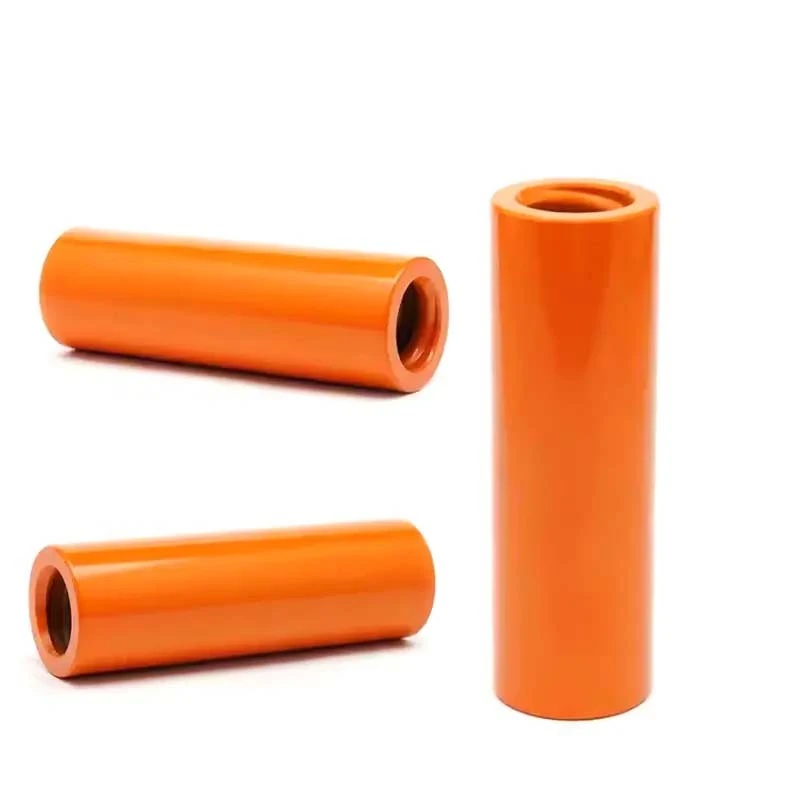
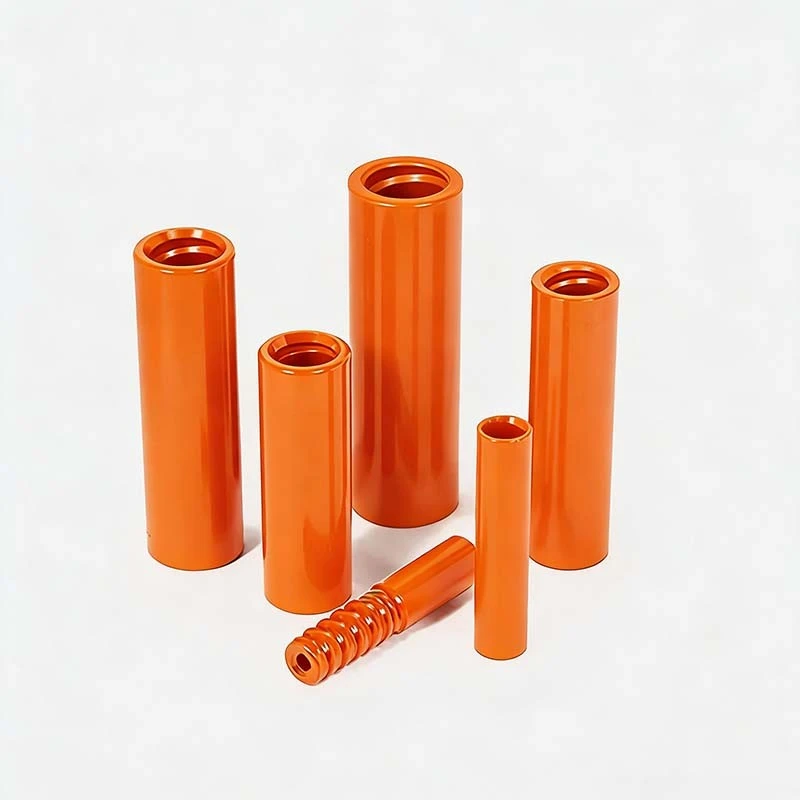
When we talk about top hammer drilling tools, the coupling, also widely known as the coupling sleeve, is far more than a simple connector. It links drill rods, shank adapters and other parts of the drill string, transferring percussive impact and rotational torque from the rock drill to the button bit. Working under repeated shock loads, vibration and rock friction, a poorly matched coupling will accelerate thread wear, waste impact energy and even cause unexpected downtime on site. For mining, tunneling, drifting and quarrying teams, knowing the different types of coupling is the first step to picking the right top hammer drilling tools for your ground conditions.
The most widely used category is the semi-bridge coupling, or half-bridge coupling. It features a built-in central stop, a non-threaded bridge section inside the sleeve. When two drill rods are screwed in, their pin ends butt against this middle bridge, preventing over-threading and keeping consistent contact. This design balances strength and maintainability. Operators can separate rods smoothly after heavy drilling cycles, which explains why it remains the standard choice for underground tunneling, drifting and routine production drilling. It works perfectly with common thread specifications such as R32, T38, T45 and T51. The only obvious limitation is minor axial clearance inside the joint, so it is less ideal for deep bench holes where zero thread play is required.
Next comes the full-bridge coupling. Unlike the semi-bridge version, its internal length is fully threaded from end to end, with no solid middle stop. Rod pins thread all the way in until they lock tightly together, removing almost all axial play from the connection. This rigid joint delivers stable energy transmission and greatly reduces the risk of thread loosening under continuous heavy impact. Full-bridge couplings shine in open-pit mining, deep bench drilling and projects where rods stay assembled for long runs. Its downside is that disassembly can be harder after intense percussion, especially if rock dust and moisture get trapped in the threads. Many drilling crews keep full-bridge couplings for fixed deep-hole programs and switch back to semi-bridge types when frequent rod changes are needed.
Beyond these core structural types, couplings are also grouped by thread standards. R-thread couplings have rounded thread geometry, suited for light to medium anchor and bolting work. T-thread couplings use trapezoidal threads with higher load capacity, built for high-torque, hard-rock drilling. No matter the thread style, reliable couplings are forged from high-grade alloy steel and go through precise heat treatment to resist fatigue and chipping.
Choosing between these coupling types depends on three practical factors: your drilling environment, how often you break the drill string, and the thread layout of your existing top hammer drilling tools. Semi-bridge couplings are the safe default for most underground jobs. Full-bridge models serve stable deep-hole production. A good coupling does not just hold rods together; it protects threads, preserves shock energy and keeps your drill string running reliably shift after shift. Taking time to match the coupling type to your drilling task will lower your consumable budget and improve overall drilling efficiency in the long run.